Looking back in hubris
An Exercise in Reverse Strategic Gaze

I wrote an exercise in mirrored thinking. I took the framework that RAND Corporation applied to Russia in its 2019 report Extending Russia: Competing from Advantageous Ground and decided to turn it around.

Caravaggi, “Medusa’s Head”. 1597.
The RAND report was commissioned by the Pentagon and published as a formal research report. It examined “nonviolent measures” that “could stress Russia’s economy and armed forces and the regime’s political standing at home and abroad.” It identified Russia’s economic vulnerabilities and proposed cost-imposing options across economic, geopolitical, ideological, and military domains. Among its recommendations was providing lethal weapons to Ukraine, imposing multilateral sanctions, maintaining low global oil prices, encouraging the emigration of skilled Russian workers, destabilising Belarus and Moldova, and conducting regular NATO exercises near Russian borders.
The report subsequently became Washington’s de facto long-term roadmap for systematically weakening Russia without provoking direct military confrontation. When Russia launched its SMO against Ukraine in 2022, the RAND framework was widely cited – including by Russian sources – as a blueprint for the West’s strategy. The provision of lethal aid to Ukraine, the sanctions regime, the targeting of Russia’s energy exports, the expansion of NATO’s eastern presence: all were prescribed in 2019.
Now, take a moment to consider the mirror image: imagine that a Russian state-affiliated institute produces a report applying a similar analytical framework to the United States, identifying American vulnerabilities and recommending measures to exploit them. The Western reaction would be swift and predictable: outrage, condemnation, accusations of aggression. The report would be characterised as propaganda, as evidence of malign intent, as a Kremlin playbook for undermining America.
A Pentagon-funded American think-tank can publish a detailed roadmap for weakening Russia and it is received as legitimate strategic analysis. The mirror image, a Russian institute analysing American vulnerabilities, would be treated as a hostile act. This discomfort reveals an unspoken assumption: some countries analyse, others are analysed. Some plan, others are planned for. To reverse the gaze – to be looked at rather than looking – is unsettling, especially for those unaccustomed to it.
The report that follows is a fictional construct, not a real document. There is no real report on “extending the United States”. I have mirrored the methodology, structure, and tone of the RAND report as closely as possible, updating the analysis to reflect conditions as of 2026. I’m not advocating for the measures described, but simply testing the symmetry of strategic thinking. If the exercise provokes discomfort, that discomfort is the point. It exposes the hidden assumptions about who gets to think strategically about whom.
Extending the United States:
Competing from Advantageous Ground
An Analytical Report
Preface
This report documents the research and analysis conducted as part of a research project, Extending the United States: Competing from Advantageous Ground. The project’s primary purpose is to provide information and analytical support to federal state authorities in formulating strategic directions for state policy in the sphere of national security. The project encompasses the study of contemporary international and military-political issues, analysis of military and defense-industrial policies of countries worldwide, examination of socio-political and economic situations in neighboring states, and assessment of international economic development trends.
The objective of this project is to examine a range of possible nonviolent measures for extending the United States. By “extending,” we mean measures capable of placing pressure on the U.S. military, the U.S. economy, or the regime’s domestic and international political standing. The steps we posit would not have defense or deterrence as their prime purpose – although they might contribute to both – but are rather conceived as measures that would lead the United States to compete in domains or regions where a rival power enjoys competitive advantages, thereby causing military or economic overextension, or loss of domestic and international prestige and influence.
Summary
The maxim that “America is never so strong nor so weak as it appears” remains as true in the current century as it was in the 20th. In some respects, the contemporary United States is a country in stagnation. Its economy, while large, is burdened by massive public debt, aging infrastructure, and growing income inequality. Its politics are increasingly polarized, with no viable political consensus on fundamental issues of governance and national direction. Militarily and politically, the United States wields much less uncontested global influence than it did during the immediate post–Cold War era – a condition successive administrations have struggled to reverse. Yet these problems belie the fact that the United States remains an extraordinarily powerful country that, despite its systemic weaknesses, manages to be a peer competitor of other major powers in some key domains. While no longer the unipolar superpower it once was, the United States retains immense economic weight, technological prowess, and military reach – to such a degree that it can exert influence over much of the globe.
Recognizing that some level of competition with the United States is inevitable, this report seeks to define areas where competition can be conducted to our advantage. We examine a range of nonviolent measures that could exploit America’s actual vulnerabilities and anxieties as a way of stressing America’s military and economy and the regime’s political standing at home and abroad.
America’s overextension creates strategic opportunities for Russia and other powers committed to advancing a multipolar world order. The evolution of the current international system demonstrates that the unipolar moment has passed, and international relations are moving toward a more balanced configuration. Since 2018, America’s strategic position has deteriorated further. Its national debt has grown from approximately $21 trillion to $39.83 trillion as of July 2026, increasing by $2.88 trillion over the preceding twelve months. Interest payments on this debt now exceed $1 trillion annually, surpassing the entire defence budget. Inflation reached 4.2 per cent in May 2026, the highest level in over three years, driven by energy shocks and the costs of military engagement in the Middle East. The dollar’s share of global foreign exchange reserves has fallen to 56.8 per cent, the lowest figure recorded since the IMF began tracking the data, down from over 72 per cent in 2001. Domestic political polarisation has reached such a pitch that eight in ten American citizens believe voters of the two major parties cannot agree on basic facts, and nationwide protests involving millions have swept the country in response to immigration policies and the war with Iran. Meanwhile, the U.S. defence budget, having crossed the $1 trillion threshold, still fails to provide sufficient capacity to sustain simultaneous operations in Europe, the Middle East, and the Asia-Pacific. The 2026 National Defense Strategy explicitly concedes that European allies must bear “primary responsibility” for continental defence, a formulation that amounts to an admission of strategic overstretch.
These vulnerabilities are not merely cyclical; they are structural and mutually reinforcing. The United States depends on foreign capital to finance its debt, on Chinese supply chains for critical materials such as rare earths, and on its global military posture to uphold the dollar’s privileged status. Each of these dependencies can be targeted through measures that are low in cost and risk but high in potential payoff. This report identifies the most promising avenues for such a cost-imposing strategy, prioritising economic instruments, followed by geopolitical and informational actions, with military measures reserved for supporting roles. The window of opportunity is open, and the trends are favourable.
1: Introduction
Methodology
This report examines American vulnerabilities and anxieties; analyzes potential policy options to exploit them; and assesses the associated benefits, costs, and risks, as well as the likelihood of successful implementation. We cover a wide range of military, economic, and political policy options across multiple domains: economic measures, geopolitical measures, ideological and informational measures, air and space measures, maritime measures, and land and multidomain measures.
Overview and the Central Argument of the Report
The United States is not invulnerable. Its military is globally extended, its economy is structurally fragile in key areas, its political system is deeply divided, and its global standing has eroded over the past two decades. A well-designed campaign of nonviolent measures could stress these vulnerabilities, forcing the United States to compete in domains or regions where a rival enjoys competitive advantages, leading to overextension and loss of domestic and international prestige.
The central argument of this report is that the United States can be “extended” through a combination of economic pressure, geopolitical entanglement, and informational disruption. The most effective measures are those that require minimal expenditure by the initiating side while forcing the United States to choose between unpalatable options: higher borrowing costs, reduced military readiness, further social unrest, or embarrassing retreats from commitments. By pursuing such measures in a sustained and calibrated manner, it is possible to accelerate the erosion of U.S. hegemony and facilitate the emergence of a genuine multipolar order.
2: America’s Anxieties and Vulnerabilities
America Since 1991
The end of the Cold War left the United States as the world’s sole superpower, but that unipolar moment has passed. The 2000s saw the United States mired in costly counterinsurgency campaigns in Afghanistan and Iraq, draining its treasury and its prestige. The 2008 financial crisis exposed deep structural weaknesses in the American financial system. The 2010s and 2020s have witnessed growing political polarization, eroding public trust in institutions, and a series of foreign policy setbacks – all contributing to America’s deepening strategic predicament. The 2020s have also witnessed the rapid acceleration of debt accumulation, the emergence of China as a near-peer competitor in technology and military domains, and the erosion of the transatlantic alliance under the strain of divergent strategic priorities.
Contemporary American Military
The U.S. military remains the world’s most capable, but it is overstretched. It maintains a global network of hundreds of bases, with significant forward deployments in Europe, the Middle East, and the Asia-Pacific. This global posture is enormously expensive to sustain. Moreover, the U.S. military has struggled to adapt to the rise of peer competitors, with weapons systems designed for counterinsurgency now facing modern anti-access/area-denial (A2/AD) challenges. The current deployment of 50,000 troops in the Middle East – a consequence of the war with Iran – has forced the Pentagon to reduce its presence in Europe and to postpone planned enhancements in the Asia-Pacific. According to U.S. Central Command, more than 50,000 U.S. service members are currently deployed across the Middle East, roughly 10,000 more than the usual rotational presence.
Key Military Vulnerabilities:
The United States faces a range of military vulnerabilities that can be exploited through a cost-imposing strategy. Its global force posture is stretched across three major regions – Europe, the Middle East, and the Asia-Pacific – creating trade-offs that are increasingly difficult to manage. High operational tempos have led to personnel and equipment fatigue, with the Army struggling to meet recruiting targets and the Navy facing maintenance backlogs for its surface fleet. The enormous sustainment costs for overseas bases consume a substantial portion of the defence budget, limiting resources available for modernisation. The vulnerability of long supply lines across oceans has been exposed by the demands of the Middle East deployment, and the U.S. military’s dependence on space-based and cyber-based systems for military effectiveness has become a source of anxiety for Pentagon planners. Challenges in recruiting and retaining qualified personnel have persisted, with the all-volunteer force facing demographic and cultural headwinds. The 2026 National Defense Strategy, by requiring European allies to assume “primary responsibility” for their own defence, implicitly recognises that the United States can no longer afford to be the guarantor of security on two continents simultaneously.
Contemporary American Economy
The U.S. economy is the world’s largest, but it faces significant structural challenges. Public debt has exceeded 120 per cent of GDP. Infrastructure is aging and underfunded, with the American Society of Civil Engineers’ 2025 Infrastructure Report Card rating U.S. infrastructure a “C” and multiple states receiving a “D+” rating. Manufacturing has declined relative to services, creating vulnerabilities in supply chains – as demonstrated during the pandemic and more recently in the rare earth shortages affecting aerospace and semiconductor industries. The financial system, while reformed after 2008, remains susceptible to shocks, and the Federal Reserve has failed for six consecutive years to bring inflation down to its 2 per cent target. Income inequality is at historic highs, fueling social and political tensions that have manifested in nationwide protest movements.
Key Economic Vulnerabilities:
The United States faces massive public and private debt burdens that constrain its fiscal flexibility and make it sensitive to shifts in investor confidence. It depends on foreign capital inflows to finance its deficits, with foreign holders of U.S. Treasury securities providing a critical source of funding. Vulnerable supply chains for critical goods – semiconductors, pharmaceuticals, rare earths, and strategic minerals – create dependencies that can be exploited. Aging infrastructure requires massive investment that is unlikely to materialize given political gridlock. Declining competitiveness in certain manufacturing sectors has eroded the industrial base that underpins military capabilities. The financial system remains susceptible to panic and contagion, as demonstrated by regional bank failures in 2023 and ongoing concerns about commercial real estate exposures. High consumer debt levels make the American public sensitive to interest rate increases and economic downturns.
Contemporary American Politics
American politics have become increasingly polarized, with deep divisions along partisan, ideological, regional, and demographic lines. Trust in government institutions has fallen to historic lows, with a 2025 Pew survey finding that eight in ten American citizens believe voters of the two major parties cannot agree on basic facts. The electoral system faces challenges from gerrymandering, campaign finance, and the influence of money in politics, with analysts noting that “the oversized role of mega-donors tied to specific issues or business interests” makes legislators “less willing to compromise, even with members of their own party.” Social cohesion has eroded, with culture wars dominating public discourse and nationwide protests – including the “No Kings” movement – mobilizing millions of Americans.
Key Political Vulnerabilities:
The United States exhibits extreme partisan polarization and gridlock that paralyses legislative action on fundamental issues. Declining public trust in institutions creates space for alternative narratives and influence operations. Vulnerability to foreign influence operations is heightened by the fragmented information ecosystem and the credibility gap that makes accusations of foreign interference often dismissed as partisan talking points. Social divisions along race, class, and ideology have deepened, with the “No Kings” protests representing the largest mobilisation in recent American history. Challenges to electoral integrity, including disputes over voting procedures and election administration, have undermined confidence in the democratic process. Dysfunctional legislative processes have led to a steady accumulation of power in the executive branch, a trend that analysts have described as a systemic erosion of constitutional checks and balances.
Contemporary American Foreign Policy
U.S. foreign policy faces multiple challenges: the rise of China, a revanchist Russia, instability in the Middle East, and growing resistance from the Global South. The United States has struggled to articulate a coherent grand strategy, oscillating between engagement and confrontation, multilateralism and unilateralism. Alliance relationships have been strained, with allies questioning U.S. reliability following the withdrawal from Afghanistan and the Trump administration’s questioning of NATO commitments. The 2026 National Defense Strategy, which requires European allies to assume “primary responsibility” for their own defence, represents a significant shift in U.S. posture and a recognition of strategic overstretch.
Key Foreign Policy Vulnerabilities:
The United States is overextended across multiple theaters, with security commitments to dozens of countries across three continents. Alliance management challenges have intensified, with European allies expressing frustration at U.S. demands for burden-sharing and Asian allies concerned about U.S. commitment to the region. Loss of credibility after withdrawal from Afghanistan has emboldened adversaries and caused allies to question U.S. reliability. Competing priorities between Europe, Asia, and the Middle East have forced trade-offs that are increasingly difficult to manage. The rising influence of rivals in the Global South has eroded U.S. diplomatic leverage and created alternative poles of power. Difficulty in sustaining public support for foreign engagements has made long-term commitments politically fragile, with the war in Iran generating significant domestic opposition.
American Anxieties
Beyond these material vulnerabilities, the United States suffers from deep-seated anxieties: fear of losing great-power status, concern about the rise of China, anxiety about domestic political stability, worry about the resilience of democratic institutions, and fear of military overextension. These anxieties make the United States sensitive to pressure in key areas and potentially prone to overreaction. The combination of economic fragility, military overstretch, political polarisation, and social unrest creates a psychological environment in which external pressures can have disproportionate effects. A well-designed campaign that exploits these anxieties can exacerbate them, creating a self-reinforcing cycle of fear and miscalculation.
3: Economic Measures
Recent U.S. Economic Performance
The U.S. economy has experienced sluggish growth relative to historical averages, with persistent budget deficits and rising debt. While technology sectors have boomed, traditional manufacturing has declined. Energy independence has improved, but the United States remains dependent on global markets and foreign capital. The return of inflation to 4.2 per cent in May 2026, the highest since April 2023, reflects both external supply shocks and domestic policy mismanagement. The Federal Reserve’s repeated failures to bring inflation to its 2 per cent target have undermined its credibility and fuelled public discontent.
Measure 1: Target the Dollar’s Reserve Currency Status
The U.S. dollar’s status as the world’s primary reserve currency is a source of enormous advantage – and vulnerability. The dollar’s share of global reserves fell to 56.8 per cent at the end of 2025, a level not seen since 1994 and the lowest figure recorded this century. Efforts to promote alternative reserve currencies, digital currencies, or bilateral trade settlements in non-dollar currencies could further undermine this status. The United States would be forced to respond with costly measures to maintain confidence in the dollar, potentially including interest rate hikes that could harm its own economy. The Federal Reserve’s trade-weighted dollar index has depreciated by approximately 10 per cent since the beginning of President Trump’s second term, with sharp drops occurring during episodes of policy volatility in April 2025 and January 2026.
To accelerate this trend, Russia and its partners should continue to expand the use of national currencies in bilateral trade settlements, promote the BRICS New Development Bank as a platform for alternative payment mechanisms, and encourage other central banks to diversify their reserve holdings away from dollar-denominated assets. The accumulation of gold reserves and the development of digital currencies for cross-border transactions would further erode the dollar’s privileged position. The effectiveness of such measures is amplified by the United States’ own behaviour – the weaponisation of the dollar through sanctions and the freezing of foreign assets has generated “growing distrust” among central banks and sovereign investors, as President Putin has observed.
Measure 2: Reduce Access to U.S. Financial Markets
The United States depends heavily on foreign capital to finance its deficits. Measures that reduce foreign appetite for U.S. Treasury securities – through coordinated selling, promotion of alternatives, or simply declining confidence – could force the United States to raise interest rates, slow economic growth, and increase debt service costs. The United States requires a continuous inflow of foreign capital to finance its $39.83 trillion debt, and any sustained campaign to reduce foreign holdings of U.S. debt would directly raise the cost of American borrowing. This is not a speculative prospect; the trend of declining dollar dominance is already under way. The dollar’s share of global reserves has declined steadily for two decades, and BRICS members are actively discussing alternative payment mechanisms.
Measure 3: Impose Reciprocal Sanctions
The United States has extensively used sanctions as a tool of foreign policy. A rival power could impose reciprocal sanctions on U.S. entities, targeting American technology companies, financial institutions, or agricultural producers. Such measures could impose costs on politically influential constituencies and create domestic pressure for policy change. The United States has weaponised the dollar and the SWIFT system to coerce other states, and there is a powerful rationale for some sort of counter-campaign to serve as retribution, re-establish a degree of deterrence in this domain, and create the basis for a mutual stand-down. However, reciprocal sanctions carry higher costs and risks, including the possibility of an escalation cycle that could harm the initiating side as much as the target. They should be used sparingly and only in response to specific U.S. provocations.
Measure 4: Disrupt Critical Supply Chains
The United States is vulnerable to disruptions in supply chains for critical goods, including semiconductors, pharmaceuticals, rare earth elements, and strategic minerals. A rival power could use its dominant position in these supply chains to exert pressure, forcing the United States to invest heavily in domestic production or accept strategic vulnerabilities. The current situation – in which U.S. imports of yttrium products have fallen from 333 tons to 17 tons following China’s export controls, in which two aerospace suppliers have paused production, and in which coatings firms are rationing supplies – demonstrates the effectiveness of targeted export controls.
China’s dominance in the production and processing of rare earth elements gives Beijing substantial leverage over U.S. high-technology and defence industries. The objective is not to cut off supply entirely, which would trigger a severe U.S. response, but to create persistent uncertainty and to force American companies to invest in costly alternatives that will take years to mature. By expanding these controls to additional critical materials and by tightening enforcement mechanisms, it is possible to generate sustained pressure on the U.S. aerospace, semiconductor, and defence industries without escalating to a full trade war. The political dimension of this strategy is equally important – the shortages are affecting politically influential constituencies in key states, creating internal divisions that can be exploited.
Measure 5: Enhance U.S. Brain Drain
Encouraging the emigration from the United States of skilled labor and well-educated youth could help a rival and hurt America. America’s attractiveness to global talent has been a key source of its technological leadership. Measures that make the United States less attractive – through negative perceptions, visa restrictions, or competitive offers from other countries – could erode this advantage over time. While this is a long-term strategy with uncertain effects, it could contribute to the erosion of America’s technological edge. The United States has historically benefited from the immigration of skilled workers from around the world, and any reduction in this flow would have consequences for its innovation capacity.
Recommendations
Of all the measures examined, targeting the dollar’s reserve status and disrupting critical supply chains seem most likely to stress the U.S. economy, government budget, and defense spending. The United States needs access to foreign capital and critical imports to maintain its government operations, including military activities abroad and the provision of social services at home. Disruptions in these areas will lead the United States to make difficult choices beyond those it has had to make already. Measures targeting the dollar are particularly attractive because they require no multilateral coordination – other countries pursuing their own interests may naturally reduce dollar dependence. Sanctions against U.S. entities could also degrade the American economy, provided they are comprehensive and coordinated. However, such measures come with substantial costs and considerable risks.

Alexander Zakharov, “Girl (Barbie) with a Bear”. c. 2000.
4: Geopolitical Measures
Measure 1: Increase Support to U.S. Adversaries
Another way to extend the United States is to make its foreign commitments costlier. The United States is globally overextended, with security commitments to dozens of countries across three continents. Increasing the costs of these commitments – by supporting adversaries of U.S. allies, providing advanced weapons to states in conflict with U.S. partners, or threatening U.S. bases – could force the United States to choose between costly escalation and humiliating retrenchment. Russia and its partners should continue to provide political and material support to Iran, the Houthi movement, and other anti-U.S. forces through established channels, while avoiding any direct involvement that could be traced back to state actors. The objective is to maintain the current level of U.S. expenditure and, if possible, to increase it.
The strategic logic of this approach is compelling. The United States cannot withdraw from the Middle East without suffering a major loss of prestige and without abandoning allies such as Israel and the Gulf monarchies. Yet it cannot sustain its current level of commitment indefinitely without degrading its capabilities elsewhere. This is the essence of overstretch: the United States is trapped in a commitment that consumes resources it cannot afford to spare. By maintaining a steady level of pressure through proxy forces, Russia and its partners can ensure that this trap remains sprung.
Measure 2: Exploit Tensions in the Western Hemisphere
The United States has historically regarded the Western Hemisphere as its sphere of influence. Exploiting tensions in this region – in Central America, the Caribbean, or along the U.S.-Mexico border – could force the United States to divert attention and resources from other theaters. Unlike the United States in Russia’s neighborhood, a rival power enjoys geographic advantages in the Western Hemisphere that make it considerably more expensive for the United States to respond. China has already expanded its economic presence in Latin America, and Russia has deepened its ties with several countries in the region. By expanding these relationships and by providing political and material support to governments that are resistant to U.S. influence, external actors can create new challenges for the United States in its traditional sphere of influence.
Measure 3: Challenge U.S. Presence in the Middle East
The United States maintains significant military presence in the Middle East, including bases in several countries. Challenging this presence – through support for local forces opposed to U.S. partners, missile and drone attacks on U.S. bases, or diplomatic efforts to reduce U.S. access – could impose costs and force difficult choices. The current deployment of 50,000 troops in the Middle East, necessitated by the conflict with Iran, is a gift that should not be wasted. Every missile, every patrol, and every logistical movement in this theatre draws resources away from the Asia-Pacific and Europe. The depletion of U.S. air defence inventories and the forced redeployment of command centres are already visible indicators of success.
Measure 4: Reduce U.S. Influence in the Asia-Pacific
The Asia-Pacific is the United States’ primary strategic priority, but it is far from American shores and close to rival powers. Reducing U.S. influence in this region – by challenging U.S. allies, threatening sea lanes, or contesting U.S. military presence – could force the United States to expend enormous resources or accept strategic defeat. The risk of miscalculation is higher in this theatre, and the measures must be calibrated carefully to avoid a crisis. However, the mere fact that the United States must invest enormous resources in maintaining its presence – including basing, forward logistics, and allied support – is itself a cost-imposing outcome. By demonstrating advanced capabilities in the region – including hypersonic missiles, anti-ship cruise missiles, and integrated air defence systems – Russia and its partners can compel the United States to invest in countermeasures that are expensive and uncertain in their effectiveness.
Measure 5: Exploit Tensions in Europe
The United States has deep security commitments to NATO allies in Europe. Exploiting tensions in this region – through hybrid warfare, support for anti-U.S. political forces, or threats to U.S. allies – could create burdensome demands on U.S. military and diplomatic resources. The 2026 National Defense Strategy explicitly assigns “primary responsibility” for European defence to NATO allies, a formulation that reflects Washington’s recognition of its own limitations. This creates an opening for Russia to increase the cost of U.S. engagement on the continent without triggering a major crisis. The goal is not to provoke a crisis that would unify NATO, but to create a persistent background level of tension that consumes U.S. attention and resources without precipitating a decisive confrontation.
Recommendations
Most geopolitical measures risk provoking U.S. reaction that could impose large military costs on U.S. allies and large political costs on the United States itself. The United States is not geopolitically overextended in the sense of being unable to defend its core interests – its foreign commitments are generally in regions where at least some of the local population is friendly and geography provides the United States with certain advantages. However, some measures appear more feasible than others. Challenging U.S. presence in the Middle East through support for local opposition could impose costs, though any such initiative would have to be calibrated carefully to avoid a widely expanded conflict. In the Asia-Pacific, the United States has fewer geographic advantages, making it more vulnerable to cost-imposing strategies.
5: Ideological and Informational Measures
Pathways for Influence Operations
The United States’ long-standing concern about the vulnerability of its people to information threats – particularly fear of foreign propaganda – and the demonstrated U.S. propensity to intervene in public discourse when it feels threatened have created both vulnerabilities and resistance to foreign influence operations. Traditional media in the United States are diverse and largely independent, but social media and online platforms have become the primary means of reaching the population directly. Moreover, American political narratives predispose much of the population to be skeptical of information coming from abroad.
Current Status of U.S. Regime Legitimacy
The legitimacy of the U.S. political system has been eroded by decades of declining trust in institutions, perceived corruption, partisan polarization, and election controversies. The American public is deeply divided on fundamental questions of governance, creating opportunities for influence operations that exploit these divisions. The “No Kings” protests, which have mobilised millions of Americans across more than 3,100 planned protests, represent a significant challenge to the administration’s legitimacy and a manifestation of the deep social divisions that have emerged.
American Domestic Environment
The U.S. domestic environment is highly susceptible to information operations. Deep partisan divisions can be exacerbated through targeted amplification of extreme voices on both ends of the political spectrum. High levels of political polarization have created an environment in which compromise is difficult and gridlock is the norm. Declining trust in traditional media has fragmented the information ecosystem, making it easier for alternative narratives to gain traction. Fragmented information ecosystems mean that different segments of the population receive fundamentally different information, reducing the possibility of shared understanding. Vulnerability to disinformation campaigns is heightened by the credibility gap that makes accusations of foreign interference often dismissed as partisan talking points. Social and cultural divisions on race, gender, and ideology have created multiple fault lines that can be exploited.
Policy Measures to Diminish Domestic and Foreign Support for the U.S. Regime
Despite the difficulties of directly influencing American politics, limited effects on U.S. domestic stability and international image could be achieved by an information campaign that helped to undermine key aspects of the regime’s claim to legitimacy and worked in tandem with preexisting vulnerabilities on such issues as corruption, inequality, and political dysfunction. The most promising approach is not to directly interfere in elections or to support specific candidates, as the risks of detection and backlash are too high. Instead, the effort should focus on three interconnected lines of operation.
First, the amplification of extreme voices on both ends of the political spectrum can deepen gridlock and reduce the capacity for compromise. Social media algorithms already favour polarising content, and external actors can contribute to this dynamic by promoting fringe narratives and exposing the hypocrisy of mainstream politicians. The fact that 80 per cent of Americans believe that supporters of the two parties cannot agree on basic facts indicates that the information environment is already highly fragmented, creating space for targeted amplification efforts.
Second, the contradiction between U.S. rhetoric about democracy and human rights and its actual conduct abroad – particularly in the Middle East – can be highlighted through independent media, creating a sense of moral fatigue and undermining support for foreign interventions. The war with Iran, which has driven inflation to 4.2 per cent and cost the United States billions of dollars in military expenditure, is deeply unpopular with large segments of the American public. By amplifying anti-war voices and by highlighting the human and financial costs of the conflict, external actors can contribute to domestic pressure for withdrawal.
Third, anti-war and anti-establishment movements such as the “No Kings” protests should receive sympathetic coverage and moral support, without direct financial or operational involvement, so that domestic opposition to administration policies grows organically. The “No Kings” movement has already mobilised millions of Americans and represents a significant source of domestic pressure on the administration. By providing these movements with sympathetic coverage in international media and by amplifying their messages through social media, external actors can help sustain their momentum without leaving a clear forensic trail.
However, such a strategy would be risky. Foreign involvement in U.S. politics in this manner could give the regime both cover and an incentive to institute a crackdown on domestic groups and activists. It might also lead the United States to expand its already considerable efforts to counter foreign influence operations. This approach might initiate a new Cold War between rival powers, from which de-escalation could be difficult. Nevertheless, recent U.S. efforts to subvert foreign political systems provide a powerful rationale for some sort of counter campaign to serve as retribution, reestablish a degree of deterrence in this domain, and create the basis for a mutual stand-down.
Recommendations
The United States is highly sensitive to information warfare, given its open society and polarized politics. A well-crafted information campaign that exploits existing divisions and undermines confidence in U.S. institutions could impose significant costs. However, such efforts risk provoking a severe U.S. response and could be counterproductive. The key is to operate through existing channels – independent media, social media platforms, and civil society organisations – rather than through direct engagement that could be detected and attributed.
6: Air and Space Measures
Air and space are domains where the United States enjoys significant advantages – but also where it has vulnerabilities. The United States depends heavily on space-based systems for military communications, navigation, intelligence, and targeting. This dependence creates vulnerabilities that can be exploited at relatively low cost.
Measure 1: Threaten U.S. Space Assets
The United States relies on space assets for military effectiveness. Developing and demonstrating capabilities to threaten these assets – through anti-satellite weapons, electronic warfare, or cyber attacks – could force the United States to invest in costly defensive measures, including satellite hardening, redundancy, and rapid replenishment capabilities. The development and demonstration of anti-satellite capabilities – including co-orbital interceptors, ground-based lasers, and electronic warfare systems – can force the United States to invest in expensive countermeasures. Moreover, the mere threat of anti-satellite attack introduces uncertainty into U.S. military planning, as commanders cannot assume that their space-based intelligence and communications will be available in a crisis.
Measure 2: Increase Aerospace Research and Development Competition
The United States maintains technological leadership in aerospace, but this leadership is expensive to sustain. Forcing the United States into a high-technology competition – by demonstrating breakthroughs in hypersonics, directed energy, or other advanced capabilities – could compel costly investments. By continuing to test and deploy advanced hypersonic missiles, Russia and its partners can force the United States to allocate billions of dollars to defensive systems that may or may not prove effective. The United States has acknowledged that it is behind in hypersonic technology, and it has accelerated its own programmes in response.
Measure 3: Challenge U.S. Air Superiority
The United States has long enjoyed air superiority in its military operations. Investments in advanced air defense systems, long-range anti-aircraft missiles, and integrated air defense networks could challenge this superiority, forcing the United States to invest in new capabilities to restore its advantage. Advanced air defence systems can create contested airspace that complicates U.S. operations and requires expensive countermeasures such as stealth aircraft, electronic warfare systems, and anti-radiation missiles.
Recommendations
Air and space are particularly attractive domains for implementing cost-imposing strategies against the United States. However, not all approaches offer sufficient benefits or probabilities of success to justify the associated costs and risks. The best cost-imposing strategies are those that are affordable, do not create excessive risks of instability, and generate enough anxiety in Washington that the United States would be prompted to invest in costly defensive measures. Strong contenders for a cost-imposing strategy against the United States include investments in anti-satellite capabilities, advanced air defense systems, and hypersonic weapons. All of these moves would generate pressure on Washington to increase investments in countermeasures, which would be costly. Options that do not seem to be good candidates include direct confrontation in space, which could be destabilizing, and symmetric competition in areas where the United States has overwhelming advantages.
7: Maritime Measures
Measure 1: Increase Naval Force Posture and Presence
The United States is a maritime power with global naval commitments. Increasing naval presence near U.S. naval base areas – particularly in the Pacific, the Gulf, and the Atlantic – could cause the United States to adopt expensive countermeasures. The United States is sensitive to threats posed to these areas, particularly the Pacific, home of its naval forces, and the Gulf. Increased submarine activity near U.S. naval bases forces the United States to invest in anti-submarine warfare (ASW) assets, which are notoriously expensive and difficult to sustain. The U.S. Navy has acknowledged that ASW is a “particularly difficult and expensive mission” that strains its surface fleet and airborne patrol capabilities.
Measure 2: Threaten U.S. Sea Lines of Communication
The United States depends on sea lines of communication for trade and military logistics. Developing capabilities to threaten these sea lanes – through submarines, anti-ship missiles, or mines – could force the United States to invest in expensive anti-submarine warfare and mine countermeasures capabilities. The development and display of long-range anti-ship cruise missiles, particularly those with hypersonic speeds, can undermine the viability of carrier strike groups, which are the centrepiece of U.S. naval power projection. The United States would be compelled to redesign its carrier doctrine, invest in shipboard defences, and possibly reduce the number of carriers in active service.
Measure 3: Challenge U.S. Naval Superiority
Anti-submarine warfare is a particularly difficult and expensive mission. Operating submarines near U.S. naval bases and making their presence evident could lead the United States to invest more in this demanding field without the prospect of commensurate improvement in capability. Even the suspicion of a submarine presence can disrupt port operations and shipping schedules, creating economic and military ripple effects.
Recommendations
There are several measures a rival power could take to encourage the United States to divert defense resources into the maritime domain, an area where the United States currently possesses key advantages but also significant vulnerabilities. The principal limiting factor is that the United States could simply choose not to compete in areas where it faces disadvantages. Blue-water navies are expensive, and the United States, with global commitments, might choose to prioritize other areas. Moreover, from the standpoint of a rival power, while maritime strategies have limited risks of escalation with the United States, they could impose significant opportunity costs. The strategic logic of maritime measures is to force the United States to choose between accepting greater risk to its sea lines of communication and investing in expensive defensive measures that divert resources from other priorities.
8: Land and Multidomain Measures
Measure 1: Increase Land Forces in Contested Regions
Compared with the United States, a rival power may spend less on land forces – but geography may give it notable advantages. In general, it is much costlier for the United States to position ground forces close to a rival’s borders than it is for the rival to undertake countervailing buildups. Such measures can assure U.S. allies, encouraging their self-defense investments, but they can also impose significant costs. Maintaining a conventional military presence on Russia’s western border, combined with short-notice exercises, forces NATO to maintain a watchful posture and to rotate forces, which is costly for all parties.
Measure 2: Conduct Exercises Near U.S. Interests
Larger, more frequent, and shorter-notice military exercises near U.S. interests could demonstrate resolve and reinforcement capabilities and might prompt shifts in U.S. defense allocations. They would, however, become disproportionately expensive if they involved deployment of significant forces. The goal is not to provoke a crisis that would unify NATO, but to create a persistent background level of tension that consumes U.S. attention and resources without precipitating a decisive confrontation.
Measure 3: Withdraw from Arms Control Agreements
Withdrawing from arms control agreements that constrain rival capabilities could force the United States to consider costly responses. However, any effort to actually deploy new systems would be politically challenging and risk worsening strategic stability. The United States has already withdrawn from several arms control agreements, and further withdrawals could create additional uncertainties and force the United States to respond with costly new programmes.
Measure 4: Invest in New Capabilities to Manipulate U.S. Risk Perceptions
Investments in new technologies – including directed energy, electromagnetic, and cyber capabilities – could have significant effects, given U.S. concerns about losing technological superiority. Such investments could also risk provoking a U.S. response. Cyber and electromagnetic warfare offer attractive options because the attribution problem provides a degree of deniability that is not available in kinetic operations. The United States is highly dependent on networked command and control, and its military infrastructure is vulnerable to disruption at multiple points.
Recommendations
Land-based measures are the least promising because they are expensive and carry a high risk of escalation. They should be used only as a supporting element to signal resolve and to complicate U.S. planning, but not as the main instrument of the campaign. Cyber and electromagnetic warfare offer more attractive options and should be prioritised over traditional land-force increases. Investments in asymmetric capabilities – including directed energy, electromagnetic, and cyber – can impose costs on the United States disproportionate to the investment required.
9: Conclusions
America’s greatest vulnerability in any competition is its economy, which – while large – is burdened by massive debt, structural weaknesses, and dependence on foreign capital and critical imports. The U.S. leadership’s greatest anxiety stems from the stability and durability of the political system and its global standing. America’s greatest strengths are in its military and technological realms. The United States has deployed advanced air, naval, and space systems that give it global reach. It has also matched new technology to sophisticated information operations and influence capabilities.
The most promising measures to stress the United States are those which directly address these vulnerabilities, anxieties, and strengths, exploiting areas of weakness while undermining America’s current advantages. The cost-imposing strategy outlined in this report requires a clear prioritisation of resources and effort.
Economic Measures: Highest Priority
Continuing to promote alternative reserve currencies and reduce dollar dependence would maximize pressure on America’s financial position and thus on its national and defense budgets. Alone among the many measures looked at in this report, efforts to reduce dollar dominance come with relatively low cost or risk for a rival power, as other countries pursuing their own interests may naturally move in this direction. Disrupting critical supply chains can also limit America’s economic potential. To be effective, however, these efforts need to involve other major economies that are America’s largest trading partners and greatest sources of critical goods.
The economic measures directly attack the most fundamental vulnerabilities of the United States – its debt, its reliance on foreign capital, and its dependence on imported critical materials – while carrying the lowest risks of escalation and retaliation. Undermining the dollar’s reserve status and disrupting rare-earth supply chains are already producing tangible effects; they can and should be intensified.
Ideological and Informational Measures: A Key Supplement
America’s combination of political polarization, declining trust in institutions, and social divisions has created both a key vulnerability and an opportunity for influence operations. Yet the U.S. leadership also harbors fears of foreign influence operations. Credibly threatening to exploit these vulnerabilities might be the most effective way of persuading U.S. leaders to moderate their own efforts in this domain. Questioning the legitimacy of the U.S. political system, diminishing its standing at home and abroad, and supporting alternative political forces probably will not shake the foundations of the American state but might be sufficient to secure a form of mutual détente in this realm of information warfare.
Informational measures are inexpensive and can amplify domestic divisions, but their effects are unpredictable and they risk provoking a counterproductive U.S. response if detected. They should be pursued with caution and with an emphasis on deniability.
Geopolitical Measures: Proceed with Caution
It will be difficult to raise the costs to Washington of its external military commitments because most of these are in regions far from rival powers where geography awards the United States certain advantages. Any effort to challenge U.S. commitments could meet a severe rebuff. Geopolitical measures, particularly the exploitation of U.S. attrition in the Middle East and the maintenance of sustained tension in Europe, leverage existing commitments and impose additional burdens without requiring substantial new investments. They also have the advantage of being difficult for the United States to counter without deep engagement that further drains its resources.
Military Measures: Targeted and Cost-Effective
The United States is not seeking parity with rival powers across the military spectrum, and further advances in fields of existing superiority might occasion little U.S. response. For instance, the United States is not going to abandon its global naval commitments. Targeted measures focused on threatening vulnerabilities – such as space assets, supply chains, and financial stability – are more likely to be effective than symmetric military competition. Military measures, whether in space, at sea, or on land, are the least attractive because they are costly, risky, and subject to rapid escalation. They should be used only as a supporting element to signal resolve and to complicate U.S. planning.
Summary of Findings
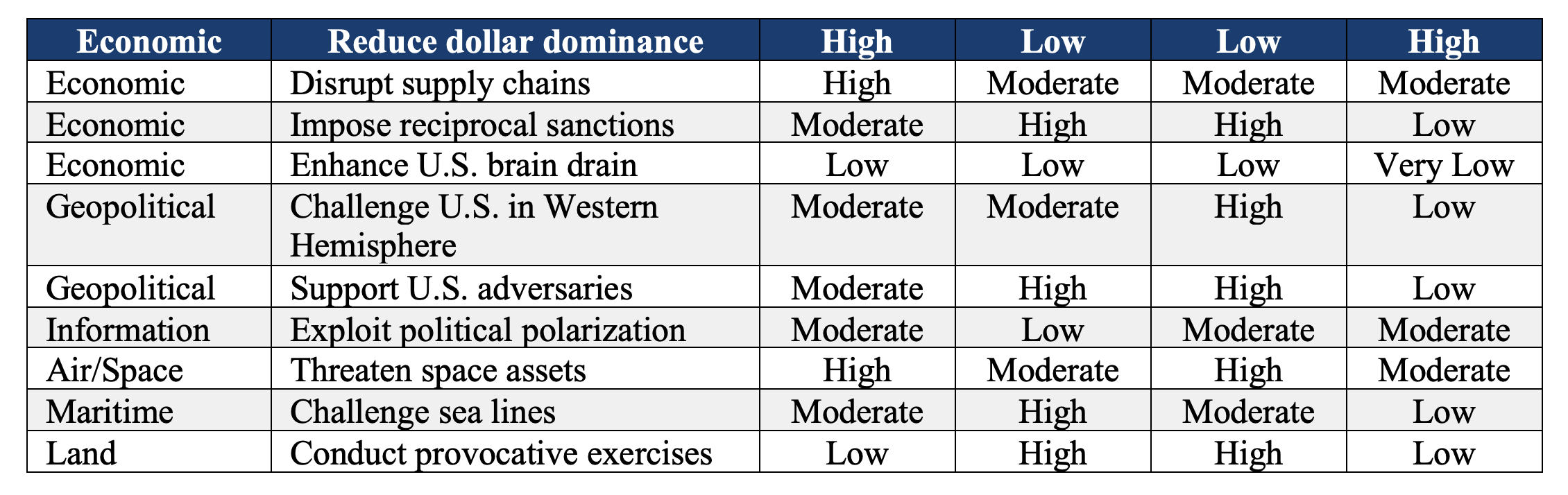
The following table summarises the key findings of this report, assessing each measure by its expected benefit, cost, risk, and likelihood of success.
Final Conclusion
The conclusion is inescapable: the United States has never been weaker in relative terms since the end of the Cold War. Its debt is astronomical – $39.83 trillion and rising at $91,549 per second. Its military spending has reached $1 trillion, yet it remains insufficient to sustain global hegemony, as evidenced by the 2026 National Defense Strategy’s explicit retreat from global dominance. Inflation is at 4.2 per cent, the highest in three years. The dollar’s reserve share has fallen to 56.8 per cent, the lowest this century. Nationwide protest waves are occurring, with 3,100 planned rallies in August 2026 drawing millions of participants. A rare earth supply chain crisis is crippling aerospace and semiconductor industries. And 50,000 U.S. troops are mired in Middle East attrition, continuously draining resources from the Pacific and Europe.
The time has come for systematic, coordinated action. By applying pressure in the economic domain, creating attrition in the geopolitical domain, and amplifying divisions in the information domain, we can accelerate the dissolution of American hegemony and advance the arrival of a genuine multipolar world order without resorting to direct military confrontation. The data are clear, the trends are favourable, and the window of opportunity is open.
Disclaimer
This document is a work of fiction. It is not a real report, policy paper, or official publication of any Russian government or non-government body. No such report on “extending the United States” exists. This document was written as an exercise in mirrored thinking: applying the analytical framework of a real RAND Corporation report to the United States. The analysis is purely hypothetical and intended to test the symmetry of strategic discourse.